
DOG AGE REFERENCE
Dog Age Chart by Size: Small, Medium, Large, and Giant Dogs
Compare estimated human-age equivalents by broad adult size, then learn when a chart is useful and when a date-of-birth calculation gives a better answer.
Reviewed on
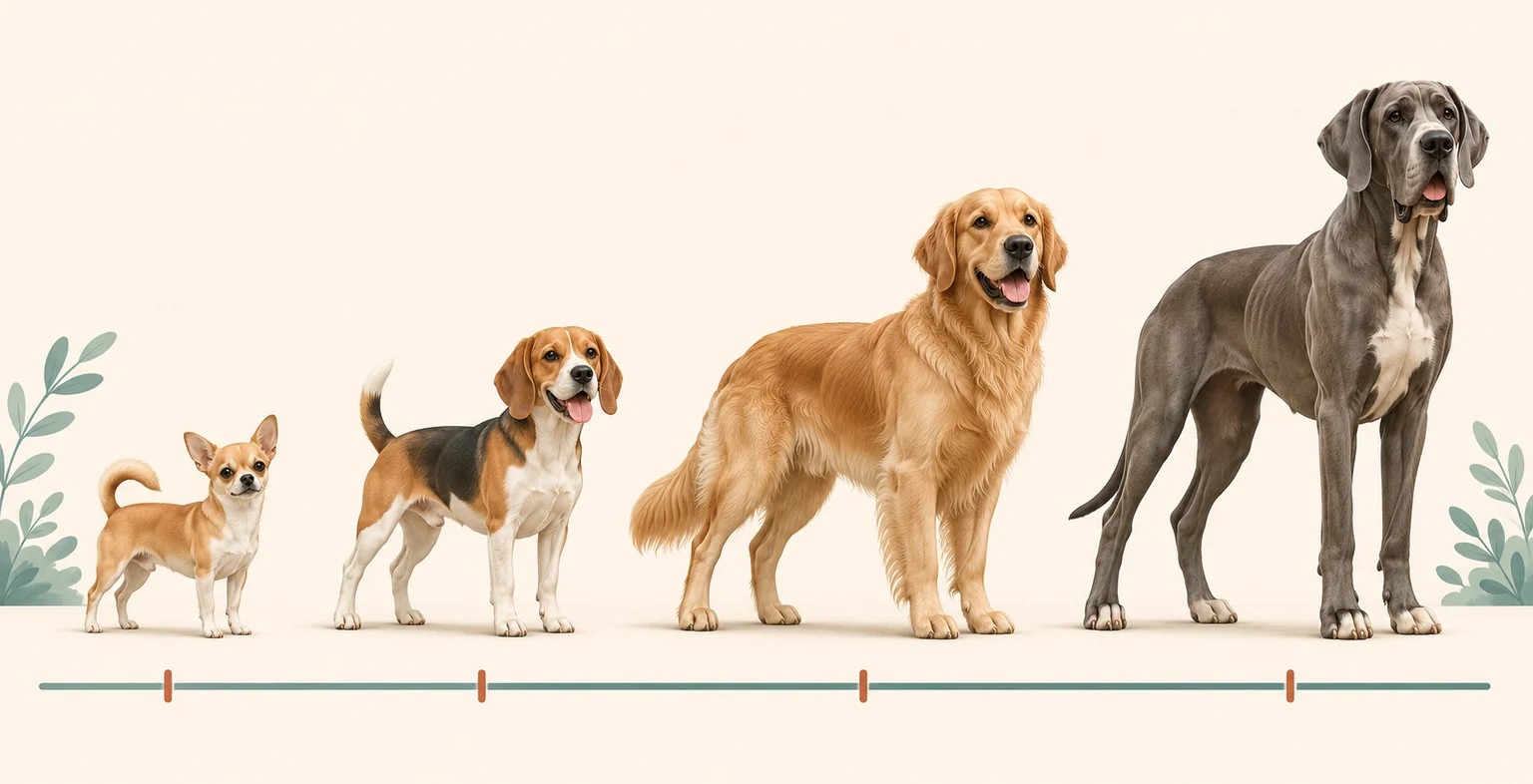
People usually open a dog age chart because they want a quick answer: what does a three-year-old dog, a seven-year-old dog, or a senior dog look like in human years? A table is useful when you need to compare several ages at once, but it can also make an estimate look more exact than it is.
Choose the column closest to your dog's expected adult size, read the number as an approximate human-age equivalent, and keep the limitations in mind. If your dog is partway through a year, use the calculator's months or birthday mode.
How to Read the Dog Age Chart
Start with the row that matches your dog's completed age. Then move across to the column for Small, Medium, Large, or Giant. These are broad adult-size groups, not a ranking of breeds. A mixed-breed dog may sit between categories, so choose the closest expected adult build and treat the result as a range.
The first two rows are the same in every column because the model treats early development as faster for all dogs. Differences appear after year two: the five-year row reads about 36 for a small dog, 39 for a medium dog, 42 for a large dog, and 45 for a giant dog.
The chart answers a reference question, not a medical question. It cannot tell you whether a dog is healthy or whether a symptom is age-related.
- Use completed dog years for a quick table lookup.
- Choose adult size rather than guessing from a puppy's current weight.
- Read every value as about or estimated, even when the table shows a whole number.
- Use the calculator for months, birthdays, ranges, and a visible formula.
Why the Size Columns Differ
The familiar seven-times shortcut gives every dog the same answer. A size-aware chart makes a different simplifying choice: all dogs move quickly through the first two milestones, while later years use a different rate for each broad size category. That makes the table more useful for comparison without pretending to reproduce every breed's biology.
In this model, the later-year rate is four human years per dog year for Small, five for Medium, six for Large, and seven for Giant. Size is only a proxy: genetics, body condition, health history, activity, and mixed-breed variation still matter.
Small dogs
Use this column for dogs expected to remain in the smallest adult-size group. Its later-year rate is the lowest in the chart.
Medium dogs
The Medium column is a practical reference for many dogs and mixed breeds, but it is not automatically correct for every dog.
Large and giant dogs
These columns rise faster after year two. That shows why size can affect life-stage timing while leaving substantial individual variation.
Dog Age Chart in Human Years
The following dog years to human years chart uses the same piecewise assumptions as the site's calculator. It covers whole ages from one to fifteen so you can scan a range without entering each value separately.
The numbers are rounded reference values, not a promise that a dog at one birthday has the same maturity, care needs, or health outlook as a person at the displayed age.
| Dog age | Small | Medium | Large | Giant |
|---|---|---|---|---|
| 1 year | 15 | 15 | 15 | 15 |
| 2 years | 24 | 24 | 24 | 24 |
| 3 years | 28 | 29 | 30 | 31 |
| 4 years | 32 | 34 | 36 | 38 |
| 5 years | 36 | 39 | 42 | 45 |
| 6 years | 40 | 44 | 48 | 52 |
| 7 years | 44 | 49 | 54 | 59 |
| 8 years | 48 | 54 | 60 | 66 |
| 9 years | 52 | 59 | 66 | 73 |
| 10 years | 56 | 64 | 72 | 80 |
| 11 years | 60 | 69 | 78 | 87 |
| 12 years | 64 | 74 | 84 | 94 |
| 13 years | 68 | 79 | 90 | 101 |
| 14 years | 72 | 84 | 96 | 108 |
| 15 years | 76 | 89 | 102 | 115 |
Months, Birthdays, and Rounding
A whole-year table cannot show the difference between a dog that is five years and one month old and a dog that is five years and eleven months old. That difference matters most during puppyhood and around a life-stage transition. The chart is therefore a starting point, not the best input for every question.
When you know the age, enter completed years and additional months. When you know the birthday, use date-of-birth mode. The browser normalizes the age, applies the same model, and rounds the displayed estimate.
If the birthday is uncertain, enter the closest age you can support instead of inventing a precise date.
- 1. Choose the input you trust. Use years and months for a known age, or use date of birth when the birthday is reliable.
- 2. Select adult size. Use expected adult build, not only a puppy's current weight or a guessed breed label.
- 3. Read the range. Keep the rounded estimate, life-stage label, and range together instead of treating one number as a diagnosis.
The Method and the Seven-Times Rule
The chart uses three simple milestones: year one is about 15 human years, year two is about 24 human years in total, and each later dog year adds a size-based rate. For a five-year medium dog, the calculation is 24 + ((5 - 2) x 5) = 39 human years.
The traditional comparison would say 5 x 7 = 35 human years. The shortcut is useful context, while the size-aware estimate is the main value here because it reflects faster early development and later size differences.
Neither approach measures biological age directly; this page names the formula so you can inspect the table's assumptions.
Limits of a Dog Age Chart
A chart is consistent by design, but consistency is not the same as precision. The size categories are broad, the displayed values are rounded, and the model does not know a dog's genetics, weight trend, health history, environment, or care routine.
The American Animal Hospital Association's senior-care guidance emphasizes that there is no single age that makes every dog senior. A chart should not turn a life-stage estimate into a fixed cutoff or lifespan prediction.
Changes in appetite, mobility, sleep, thirst, weight, breathing, pain, or behavior are reasons to contact a veterinarian, whether or not a chart labels the dog mature or senior.
- Do not use the chart to diagnose illness or decide whether a symptom is normal.
- Do not treat a breed-to-size mapping as a breed-specific aging curve.
- Do not compare a rounded human-age value with a medical age test that uses different evidence.
- Use a licensed veterinarian for symptoms, medication, diet, pain, mobility, or lifespan questions.
When to Use the Calculator Instead
Use this chart when you want a quick scan across ages or a simple way to compare size columns. Use the dog age calculator when the result needs to match a specific dog and a specific input. It accepts years and months or a date of birth, shows the formula, adds a range, and keeps the traditional comparison secondary.
Enter the age you know, choose the closest adult size, and review the life-stage label as context. If you only know a breed, use it as a starting point for size and adjust it for an unusual mix or build.
For reverse conversion, use the human-years-to-dog-years calculator. For the separate senior question, read the senior life-stage guide.
Dog Age Chart FAQ
What is the most useful dog age chart?
A useful chart states its method, separates broad size categories, shows the actual rows, and explains its limits. This chart uses 15 human years for year one, 24 total for year two, then a size-based rate from four to seven human years per later dog year.
How old is a 5-year-old dog in human years?
This chart estimates about 36 human years for a small dog, 39 for a medium dog, 42 for a large dog, and 45 for a giant dog. The calculator can refine the result when months or a birthday are known.
Does one dog year equal seven human years?
Not exactly. Seven times is a familiar shortcut, but it treats every year equally. Dogs mature quickly during the first two years, and later estimates can vary by size, so this site shows the shortcut separately from its main chart.
Which size column should I use for a mixed-breed dog?
Choose the closest expected adult size. If the dog is between categories, compare the two neighboring columns and keep the result as a range. A breed label can suggest size but cannot make the estimate exact.
Can I use a dog age chart for a puppy's months?
A whole-year chart is too coarse for many puppies. Enter completed years and additional months, or use a reliable date of birth, so the calculator can normalize the age before applying the same method.
Does the chart tell me when my dog is senior?
It can provide general age context, but it does not set a universal senior cutoff. Senior timing varies by size and individual. Read the senior life-stage guide and ask a veterinarian about actual health or behavior changes.
Sources and Method Notes
The table is a transparent educational model used consistently with the calculator. The external guidance below supports the limitation that life-stage timing varies; it is not a claim that the chart is a clinical test.
- 2023 AAHA Senior Care Guidelines for Dogs and Cats Provides life-stage context and explains why one fixed senior age does not fit every dog.
- Dog Age Calculator method and chart Shows the same size-aware assumptions, calculator inputs, range language, and table values used here.