
DOG LIFE STAGES
When Is a Dog Considered a Senior?
There is no single birthday that fits every dog. Use expected lifespan as context, then treat the estimate as a conversation starter rather than a medical label.
Reviewed on
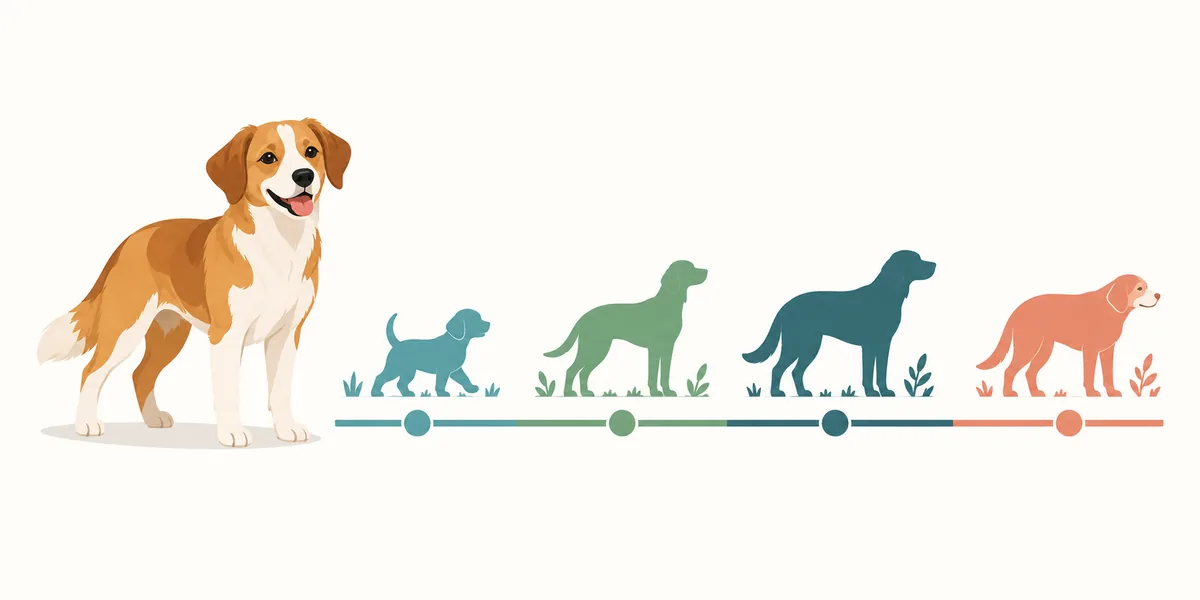
When is a dog considered a senior? There is no one age that applies to every dog. The American Animal Hospital Association (AAHA) explains that differences among breeds and individual animals make a universal birthday unreliable. Its 2019 canine life-stage guideline defines the senior stage as the last 25% of a dog's estimated lifespan.
That definition is useful because it explains why a single age chart can be misleading. A lifespan estimate is uncertain, and a dog is an individual rather than an average. The calculation below shows how the framework works; it does not predict how long a particular dog will live or replace advice from a veterinarian.
What the final-quarter definition means
The 2019 AAHA Canine Life Stage Guidelines place a dog in the senior stage during the final quarter of its estimated lifespan. AAHA's 2023 Senior Care Guidelines repeat this definition and note that no specific age denotes senior status across all breeds. The guideline is a life-stage framework: it helps organize care discussions, but it is not a date on which every dog changes in the same way.
The arithmetic is straightforward. Multiply an estimated lifespan by 0.75 to find the point at which the final quarter begins. For a hypothetical lifespan of 12 years, 12 × 0.75 = 9, so the framework would place the transition around age 9. The number 12 here is an example input only; it is not a claim about the lifespan of a particular breed or an individual dog.
If a trustworthy lifespan estimate is a range, apply the 75% calculation to both ends and keep that uncertainty visible.
| Assumed lifespan | 75% point | Meaning |
|---|---|---|
| 8 years | about 6 years | Illustration of the calculation |
| 12 years | about 9 years | Illustration of the calculation |
| 16 years | about 12 years | Illustration of the calculation |
Why senior ages vary
A dog-age chart often gives an easy-to-remember threshold, but any simple chart hides assumptions. Breed, body size, genetics, health history, and the source's definition of lifespan can all affect the estimate. Even dogs that look similar can have different histories and needs. A number can orient a conversation, yet it cannot describe an individual dog's whole life stage.
Size is sometimes used as a broad clue because groups of dogs can differ in average aging patterns. It should not be turned into a rigid rule such as 'small dogs become seniors at exactly this birthday.' Mixed-breed dogs may not fit a single category, and a size label does not account for every inherited or environmental factor.
The word 'senior' is a practical category, not a diagnosis. It does not establish that a dog is ill or needs a particular diet, medication, or exercise plan; those decisions depend on the individual dog.
- The expected-lifespan estimate may be broad or uncertain.
- Breed and size categories describe groups, not a guarantee for one dog.
- Health, genetics, and lived experience are not captured by age arithmetic.
How to make a careful estimate
If you want to use the final-quarter model, write down the lifespan assumption before doing the calculation. This small step makes the estimate transparent. It also makes it easier to update the answer if you later receive more relevant information about your dog or learn that the original lifespan source used a different population or method.
Do not choose a lifespan to produce a preferred age. If you cannot find a relevant, trustworthy estimate, state that the input is unknown and use the framework only as general context.
- Start with what you know. Use the dog's recorded age and any reliable breed or background information. Mark estimated details as uncertain.
- Choose a lifespan source carefully. Prefer veterinary or well-documented population information. Do not treat a breed average as a promise for an individual dog.
- Apply the same calculation. Multiply the assumed lifespan by 0.75. If the input is a range, calculate both endpoints rather than hiding the range.
- Describe the result as approximate. Say 'around this point under this assumption,' not 'your dog becomes senior on this date.'
Changes worth documenting, not using as proof of age
Age and observed changes answer different questions. A change in movement, sleep, appetite, body condition, hearing, vision, or behavior does not by itself prove that a dog has reached a senior stage or identify its cause. The same change can have many explanations, and some may need professional attention regardless of age.
A simple record can make a conversation more useful. Note when a change began, whether it is becoming more frequent, what activities are affected, and what else changed around the same time. A short video of a movement concern may help a veterinarian understand what you observed, if recording it is safe and does not delay care.
Do not wait for an age threshold if a change is sudden, severe, painful, or worrying. This article cannot assess symptoms remotely. Contact a veterinarian for advice that takes your dog's history and current condition into account.
- Record the date and a plain description rather than labeling a change as 'just old age.'
- Include appetite, activity, sleep, mobility, and behavior only when they are relevant to your concern.
- Keep notes factual: what happened, how often, and whether the pattern is changing.
- Seek veterinary guidance for new or concerning changes instead of using a senior-age chart to explain them away.
What the senior label does not mean
A senior label does not mean a dog is ill, uncomfortable, or unable to enjoy its usual activities. It also does not mean that every dog needs the same checkup schedule, food, supplement, medication, or exercise change. The category is a prompt to consider context, not a treatment plan.
It does not tell you how much time an individual dog has left. The final-quarter calculation is based on an estimated lifespan, and an estimate is not a countdown. A dog may live shorter or longer than a group average. Avoid using the calculation to make a personal prognosis or to compare the value of one dog's life with another's.
A human-age conversion and a life-stage category answer different questions. A calculator applies a stated formula; the senior framework compares a dog with an estimated lifespan. Neither measures health precisely.
When to talk with a veterinarian
A routine veterinary visit is a good place to ask how the senior-stage framework applies to your dog. Bring the dog's age, known breed or mix, relevant records, and a list of changes you have noticed. A veterinarian can interpret that information alongside an exam and history; this page cannot do that remotely.
Ask whether the lifespan assumption is appropriate and which changes should prompt an earlier appointment. Lead with a specific concern instead of waiting for an age milestone.
- Which lifespan estimate, if any, is reasonable for my dog's background?
- What should I monitor between routine visits, given my dog's history?
- Which new changes need prompt attention, and which can be tracked for follow-up?
- Would any preventive-care plan change for this individual dog, and why?
Frequently asked questions
When is a dog considered a senior?
There is no single age for every dog. The 2019 AAHA Canine Life Stage Guidelines define senior dogs as being in the final 25% of estimated lifespan. For a hypothetical 12-year lifespan, that point is about age 9; the lifespan assumption and result are estimates, not a diagnosis.
Is a dog senior at 7 years old?
Not automatically. Seven years may be used as a broad rule of thumb in some age charts, but the AAHA lifespan-based definition does not make seven a universal cutoff. Consider the lifespan assumption and ask a veterinarian how it applies to an individual dog.
Do small dogs become seniors later than large dogs?
Size can be one broad factor in lifespan estimates, but it does not set an exact age for every dog. Breed, mixed ancestry, health history, and other individual details matter. Avoid turning a group-level pattern into a guaranteed birthday.
How do I calculate the final 25% of a dog's lifespan?
Multiply the estimated lifespan by 0.75 to get the point at which the final quarter begins. For example, 12 × 0.75 = 9 years. This arithmetic only illustrates the guideline; it cannot predict an individual dog's lifespan.
Does being a senior mean my dog is sick?
No. Senior is a life-stage description, not a diagnosis. A new or concerning change should be discussed with a veterinarian rather than explained away as age.
Should I wait for a senior age before asking about a change?
No. Contact a veterinarian about a sudden, severe, painful, or worrying change at any age. The senior framework is for general life-stage context, not a reason to delay care.
Sources and method
The age-stage definition below is attributed to the published AAHA guidance. The numerical examples on this page are arithmetic demonstrations of that definition, not clinical recommendations.
- 2023 AAHA Senior Care Guidelines for Dogs and Cats The executive summary states that no specific age denotes senior status across breeds and summarizes the 2019 canine guideline's final-quarter definition.